Cecílie Jílková (born in Prague in 1981) is a Czech writer, journalist and singer. She grew up in the heart of the Czechoslovak dissident movement: her father was the writer Ludvík Vaculík, author of the Two Thousand Words manifesto and a close ally of Václav Havel, her mother is the writer Lenka Procházková, and her grandfather was the novelist and screenwriter Jan Procházka.
After her first novel, Journey to Drromm (2010), feuilletons for Lidové noviny, the oldest Czech daily, and scripts for the TV series Kriminálka Anděl, she spent a decade writing about healthy eating and published four books on the subject, two of which became bestsellers. She returned to literature with the autobiographical novel Father God and Mother Love. Today she writes about digitalization and freedom of speech on Substack and for the American magazine Public. She lives in Prague.

A Family Against Tyranny
Three generations of Cecílie’s family stood up to two totalitarian regimes. Her great-grandfather Přemysl Micka, a village headmaster, worked for the anti-Nazi resistance and was tortured by the Gestapo and died in their custody in 1943. Her grandfather Jan Procházka, one of the leading writers of the Czechoslovak New Wave, was banned after the Soviet invasion of 1968 and hounded to an early death by a state television smear campaign. Her father Ludvík Vaculík wrote the Two Thousand Words manifesto, ran the underground publishing house Petlice and helped Václav Havel found Charter 77. Her mother Lenka Procházková became an “enemy of the state” at eighteen, simply for being her father’s daughter.
Father God and Mother Love
A memoir of dissent, addiction, and the price of freedom.
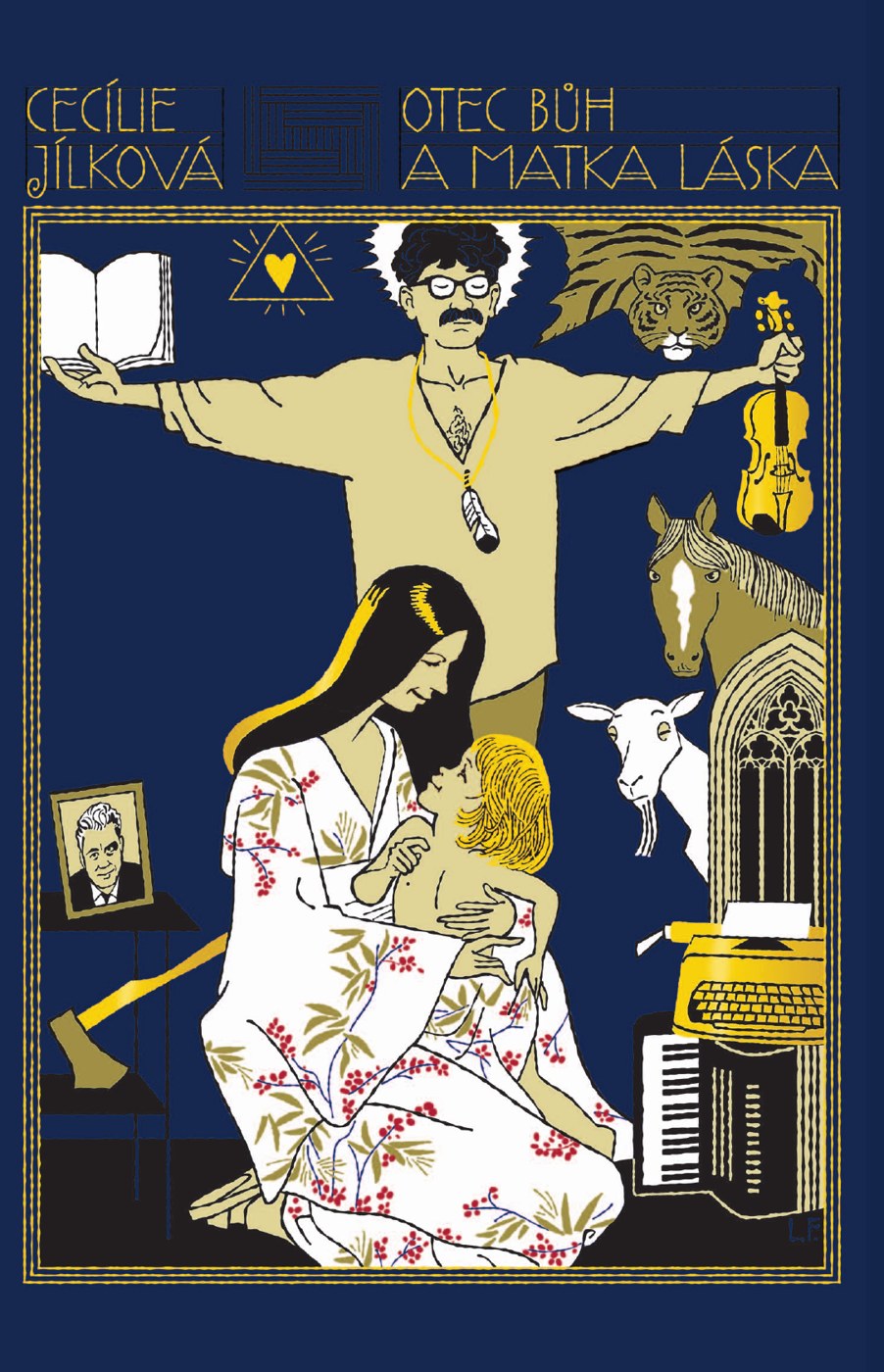
The daughter of two Czech dissidents describes a childhood under communist totalitarian rule and coming of age in the years after the Czechoslovak Velvet Revolution. What was intended as a simple account of wild youth unexpectedly develops into a gripping story about what shapes us: parenthood, partnerships, friendships, and one’s relationship with oneself.
The first half reads like Christiane F. set in post-revolution Prague: a childhood in a bugged apartment, adolescence in the euphoria of the Velvet Revolution, the nineties in which Prague became a hub of the European drug trade. The second half turns inward: a marriage destroyed by alcoholism, a premature birth, a violent relationship and the death of her father, written with the same merciless candour that made Vaculík’s Czech Dreambook a classic of European literature.
Book Trailers
Short films made from the family archive, with passages from the book. English subtitles.
Essays
On fear, authority and the people power labels as “anti-establishment.”
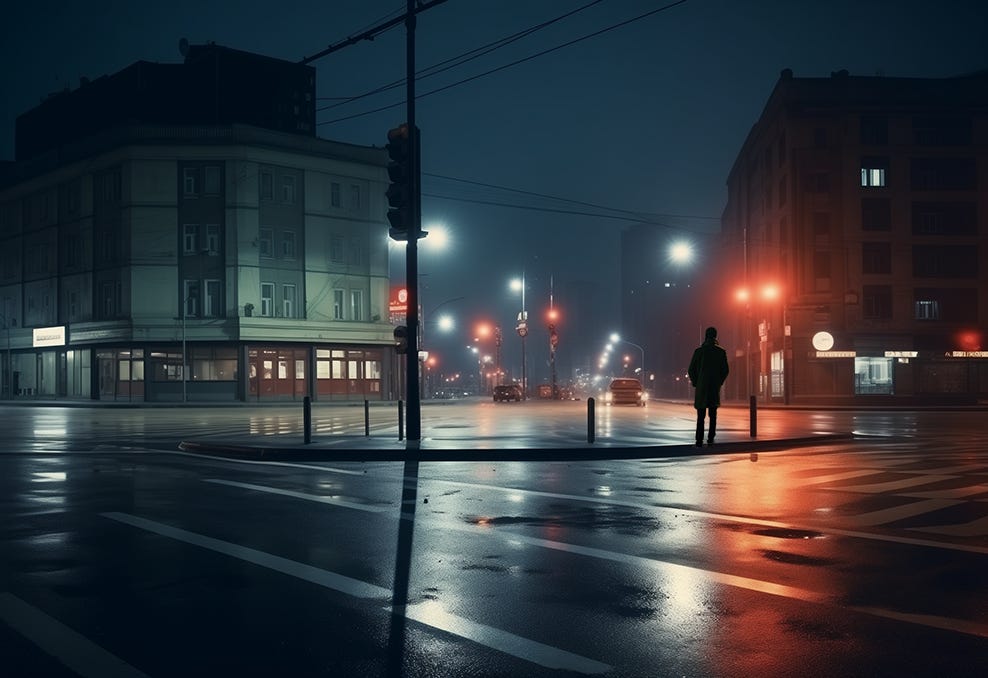
Cross on the Red, People!
Taking responsibility for our own lives automatically means disregarding authorities that don’t deserve our respect in the first place.
Read the essay ↓
“This intersection is controlled by traffic lights,” my mum used to tell me whenever we stood at a crosswalk by Prague’s Dancing House (which, of course, wasn’t there yet back in 1988). She did so repeatedly, reminding me that this intersection was busy and that crossing it on a red light was rather discouraged. Later on, I was hit by a taxi just around the block. Some children just seem to have a mind of their own.
But the Light is Red
And some just don’t. “Thanks to our little eyes and ears, though, we know nothing is coming our way,” I had to then explain to my daughter when she hesitated to cross on a red light. Eventually, I had to add that besides cars (let alone trolleys!), she also has to check for cops. As it turns out, some cops are capable of fining a pedestrian for crossing an empty intersection.
Traffic Lights Don’t Have Eyes… Yet
I had to explain to her that traffic lights are dumber than humans, because they don’t have eyes or ears and can’t tell when cars are actually passing—that traffic lights function only thanks to the humans who programmed them, and that it shouldn’t be the other way around: Humans shouldn’t function thanks to the traffic lights that programmed them.
Lies, Nothing but Lies!
Before the Velvet Revolution, our father’s favorite adrenaline-inducing activity was to watch Televizní noviny, a state-controlled news program. After pulling his chair up three feet from the TV screen, he would comment on the news content by yelling, “Lies! Nothing but lies!” We kids found it incredibly amusing.
Our parents taught us that the media lies, the state lies—and since first grade, they taught us to confront our teachers about their untruths. (We were able to do this, mind you, because our family’s political profile simply could not get any worse.) By doing that, they automatically taught us to disregard authorities that don’t deserve our respect in the first place.
Thus, by default, they taught us to show no respect even to them, should they ever fall short of deserving it. Most of the time, however, we did listen to them. As far as I know, we usually did so because it was worth it and we loved them, but occasionally also because they just happened to be right.
Free Pedestrians
Crossing the street on a red light when appropriate and after careful consideration means taking responsibility—not only for our own lives but also for the lives of other road users. Conversely, automatically obeying traffic lights without a second thought means renouncing that responsibility. Which one deserves to be more cultivated?
Pedestrians have the advantage of being able to see in all directions. Free from the confines of a car, they can spin around their axis like a top to check for any potential saber-toothed Bobcats barreling toward them from the right or tanks from the left. By doing so, they refine both their reflexes and their judgment.
Changes of Authorities
A telltale sign of totalitarianism is when advisory bodies become governing ones. It is indeed interesting how the idea of not putting blind faith in all kinds of authorities doesn’t occur to many people today, and how many people cannot even think of disobeying various and utterly illogical orders.
A fitting metaphor for this might be a small group of people hesitating to cross against a red light, even though there is no traffic. The road is empty, but the light is still red…
And so, dear children, if they haven’t met their end yet, these people are still standing at that intersection to this very day.

Don’t Be Afraid!
Fear and tribalism are self-defence tools. Courage and independence are weapons. Rolling with the punches in armour forged by habit won’t lead to victory.
Read the essay ↓
Žižkov Tunnel connecting Prague’s districts of Žižkov and Karlín.
One day, a spray-painted message suddenly appeared above the entrance to Prague’s most terrifying pedestrian tunnel: Don’t be afraid. The tunnel stretches over 300 meters. That translates roughly to a brisk seven-minute walk while hoping you won’t get mugged on your way through.
Every day, countless pedestrians pass through it perfectly at ease, completely unaware they’re walking through a fallout shelter or passing by the door to a particle-accelerator laboratory, which was once a warehouse for storing corpses. Don’t be afraid…
Breaking down the Barriers as a Survival Strategy
There is something within us that longs to overcome our fears and break down the barriers of discomfort with our own bare hands. The thought of accidently falling onto the Metro tracks has always terrified me. Later, I started to feel something like a physical urge to hurl myself onto those tracks, solely because of that fear of death. Just to be finally free from that uncomfortable pull. No, I won’t jump—that’s a promise.
I’ve always loved jumping into cold water. I’m sure a lot of people know that feeling. Jumping into freezing water, skydiving, or bungee jumping is enjoyed by many. Immediately after taking the leap, endorphin levels increase.
Seeking out new experiences, exploring new stimuli and situations, for a change, engages the dopamine system. As an animal species, humans feel the need to figure out the answers to such simple questions as: “Will I enjoy this new food, or not?”
A Defect That Might Come in Handy
I’ve always thought of my parents as very courageous. All those interrogations, wiretappings, and house searches, all that manipulation and the attacks on human dignity via disinformation campaigns, intimidation tactics, restriction of fundamental rights and freedoms…
It wasn’t until later that I realized they were, above all, perpetually and fundamentally pissed off. And when you are angry, you lose your instinct for self-preservation. A certain part of this “anomaly” was passed down to me as well, at least when it comes to my relationship with official authorities, that aren’t really authorities at all. Human dignity isn’t handed out by the state—it’s self-generated through human behaviour.
Don’t Be Afraid!
Fear is a source of information. A feeling designed to warn us what to watch out for. We need this instinct. The absence of self-preservation is not courage but a defect. Similarly, excessive fear, which may manifest as paralysis, is equally a disorder.
As I more or less envision it, a reasonable amount of fear is when your instinct says: “Watch out!” And you respond with: “Thanks!” Whatever follows next is directed by your own nature: You either don’t go into the tunnel, or you do and factor in the risk. You’ve received information. You can set your fear aside. What purpose does it serve to remain afraid of the same old thing? What new insight does it bring? After transmitting information, fear becomes a superfluous emotion.
I Don’t Know
Today, in the age of fostering anxiety as a disease of affluence, eliminating uncertainty can serve as a strategy to reduce fear. That, however, comes with its side effects—such as the polarisation of society.
The biggest ovations have always gone to pathos and demagogy, for they assure us we belong to a group. Those in a group get to enjoy a pat on the back and a collective circle jerk over the fact that it’s the “others” who are in the wrong. Acknowledging that the truth is not clear, that it lies somewhere in the middle of everything, of which we only know half, means to embrace uncertainty, to walk away from our tribe, and stand alone.
Unless, of course, “I don’t know” is itself a strategy to reduce fear and stress. By keeping an open mind to various solutions, I improve my chances of eventually reaching the right outcome. And while I lose the opportunity to strut around in front of “all the other idiots” who are in the wrong—since I don’t know yet if they truly are—at least I won’t end up being the idiot myself. I don’t know allows us to let go of that anxious control over what the truth is, because we just don’t know. It enables us to either wait patiently for the truth to come out on its own, or to be curious and seek it out ourselves. And in doing so, to try to reach the real truth. Not just an argumentative victory.
Fear of Change
In my book Otec Bůh a matka Láska (Father God and Mother Love), I also mention how our brain’s adherence to stereotypes drives us to fear change. That’s why getting started is always the hardest part. Taking the first step seems impossible. After that initial step, however, nothing is as difficult anymore. Little by little, I learned that it’s possible to stop paying attention to fear. Our minds are constantly shifting between multiple parallel layers. And while we are deathly terrified in one, we can start to gently and inconspicuously take steps in another.
To slowly but surely inch toward the tunnel—the tunnel being a metaphor for any change that terrifies us. To move through the tunnel in baby steps, without paying too much attention to any of it. It’s much like outsmarting procrastination by starting gradually, with “just a draft” and “no pressure”.
Shedding Your Armour and Taking up Arms
Telling yourself, “Don’t be afraid” and “I don’t know,” means becoming more vulnerable, because fear and tribalism are tools of self-defence. At the same time, however, it means becoming stronger, as courage and independence are weapons. Rolling with the punches in armour forged by habit won’t lead to victory.
Anti-establishmentarians of Europe
In times when human rights are being restricted, it is only natural for people to turn away from the center of power.
Read the essay ↓
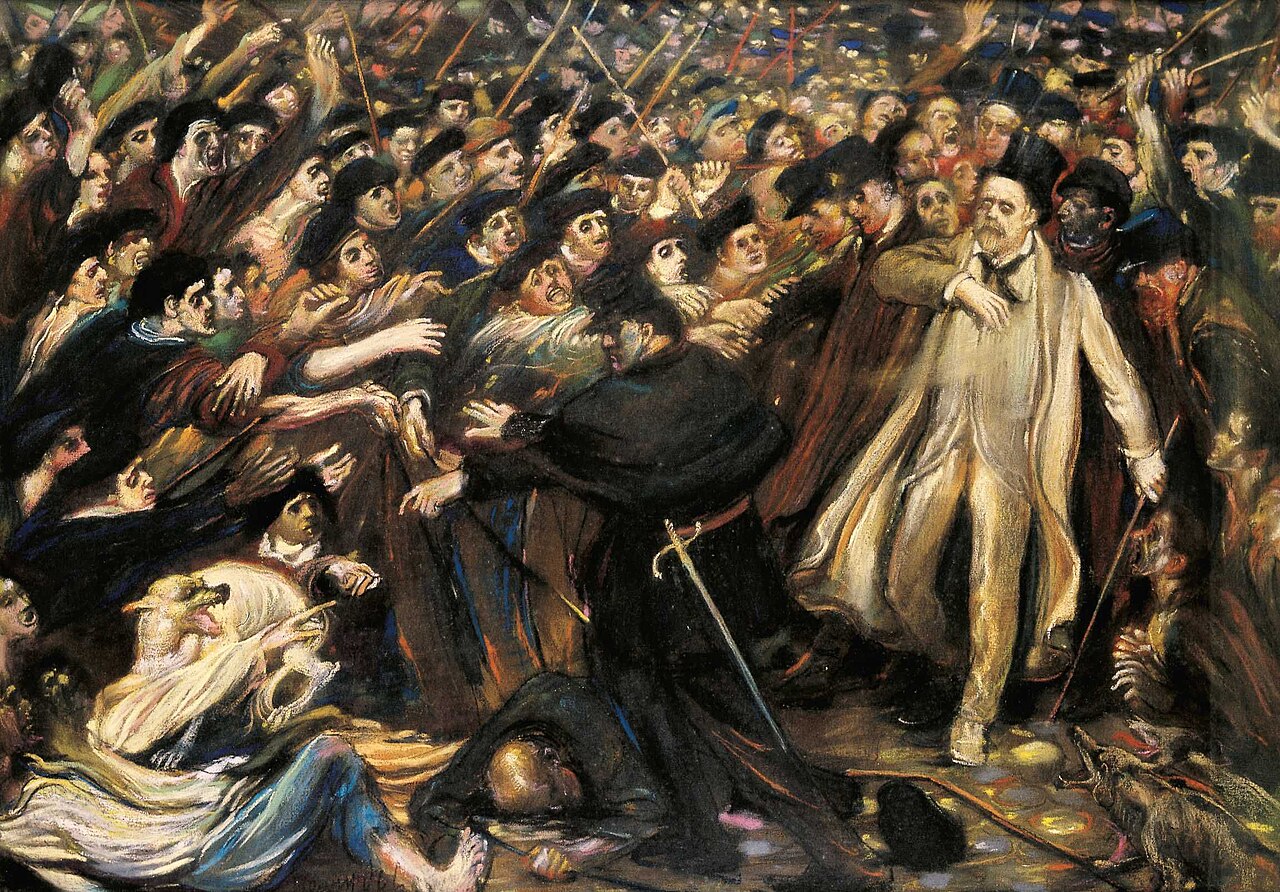
Zola Faces the Mob, oil on canvas by Henry de Groux, 1898. Source: Wikimedia Commons

“Anarchists of the lecture-platform” was a derogatory term used for French intellectuals during the Dreyfus Affair. It was coined by Maurice Barrès, a politician, journalist, and leading opponent of Alfred Dreyfus, an artillery officer who was first wrongly and then unjustly accused of treason.
On October 15, 1894, Dreyfus was arrested and charged based on a handwritten letter sent to the German Embassy and intercepted by the French counter-intelligence service. Following a flawed handwriting analysis, the letter was determined to have been written by Dreyfus.
This mistake was later uncovered by Georges Picquart, the new head of counterintelligence, whose superiors, however, refused to reopen Dreyfus’s case. Moreover, in August 1898, it was brought to light that the agency had forged evidence in an effort to prove Dreyfus guilty.
Praise and Punishment
The prominent figures of the Académie Française deemed the intellectuals demanding justice for the imprisoned officer to be “some of the most ridiculous eccentrics” who dared to “treat our generals as idiots” and “our social institutions as absurd.”
In his book Who Rules the World?, Noam Chomsky recalls the American philosopher John Dewey, who was also dubbed an “anarchist of the lecture-platform” for denouncing the “unfree press” and questioning “how far genuine intellectual freedom and social responsibility are possible on any large scale under the existing economic regime.”
Ironically enough, as long as Dewey helped fuel war enthusiasm in American society during World War I, he escaped such disparagement. According to Chomsky, the practice of dividing intellectuals into “good” and “bad” is an old favorite, with the harshest treatment reserved for those who doubt “the nobility of war aims.”
Experts on Truth
When a Czech Justice of the Constitutional Court spoke about free speech and social media on national public television, stating that “lies are not an opinion,” I took the liberty of pointing out that this slogan had been tarnished by the so-called “experts on disinformation” who spread untruths about, for example, the safety and efficacy of vaccines. As revealed not only by the Twitter Files but also by many researchers much earlier, truthful information was removed from social media at the behest of these “experts.”
The absurdity of the phrase “expert on disinformation” becomes apparent the moment we realize that it is effectively synonymous with the phrase “expert on truth.” Even by simply applying common sense, we can infer that when someone fancies themselves an “expert on truth,” only one thing is clear: they are wrong.
Anti-establishmentarians
A discussion unfolded in the thread below the aforementioned X post, during which someone suggested that my worldview is anarchistic. There was no other way to respond to this than by quoting the 45th session of the Presidium of the Central Committee of the Communist Party of Czechoslovakia, held on September 19, 1967. It was convened for the purpose of disciplinary proceedings against my father, the writer Ludvík Vaculík, as well as other “anti-establishment” intellectuals:
“Owing to his character traits, Ludvík Vaculík would occasionally get into workplace conflicts. In recent years, affected by this and by the unsound environment found among some intellectuals, Vaculík has fallen outside the ideological influence of the Party, has slipped into depression, fails to see the prospects of socialism, his views are heavily imbued with elements of anarchism.”
In times when human rights are being restricted, it is only natural for people to turn away from the center of power. If possible, power and its institutions then protect their continued existence by labeling these people as enemies of the state, as happened to my grandfather Jan Procházka, or as anarchists, as happened to my father Ludvík Vaculík.
When politicians run out of arguments—since the critics non grata are neither Russian agents nor cheats and liars—there is nothing left but to outright brand them as anti-establishment. Citizens must be convinced that without the current system, they wouldn’t know how to manage. In reality, however, this propaganda doesn’t actually safeguard democracy or the political system as such but only the current regime. This is where we currently stand in Europe.
Songs
Cecílie sings jazz standards and Czech songs. Two videos and her album O všem (About Everything) on BandLab.
Other Books
Published in Czech.

Journey to Drromm
A novel set in the near future. Teodor, a young man facing a terminal illness, leaves Earth to spend the time he has left on the newly discovered planet Drromm.

The Complete Guide to a Lifestyle Change

Recipes for the Whole Year

My Sugar-Free Treats

Recipes for the Whole Family
Articles & Interviews
Investigative reporting for the American magazine Public, founded by Michael Shellenberger, and an interview for the Brazilian publication A Investigação.
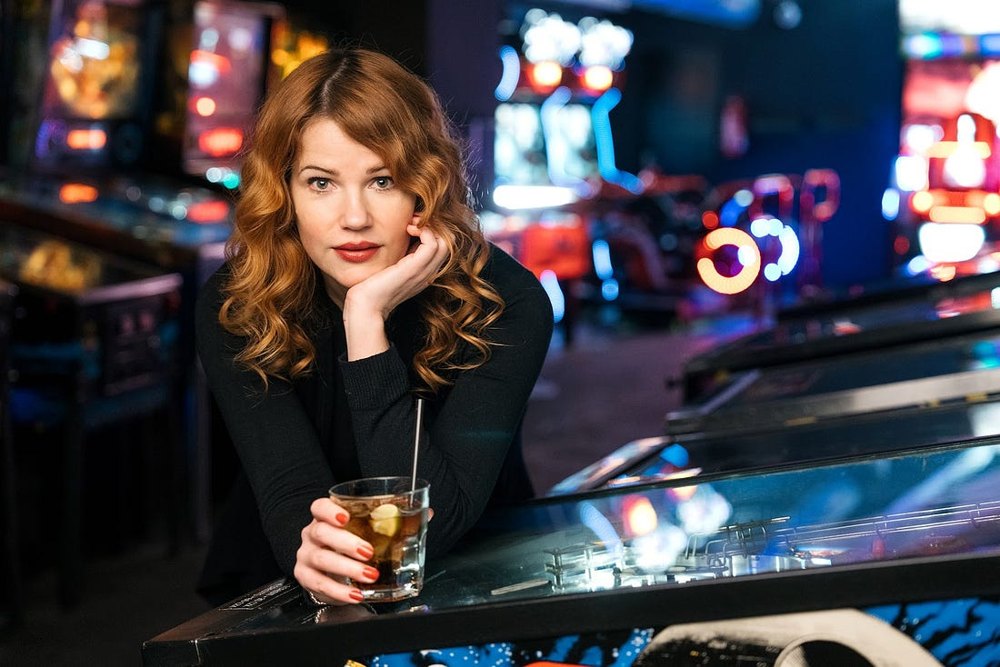
From Samizdat to Substack: Lessons from Czech Resistance to Censorship for Today’s Brazil
Interview by David Agape on the abuse of power, the laws of power defined by Ludvík Vaculík, and the risks of digital censorship. English translation of the Portuguese original.
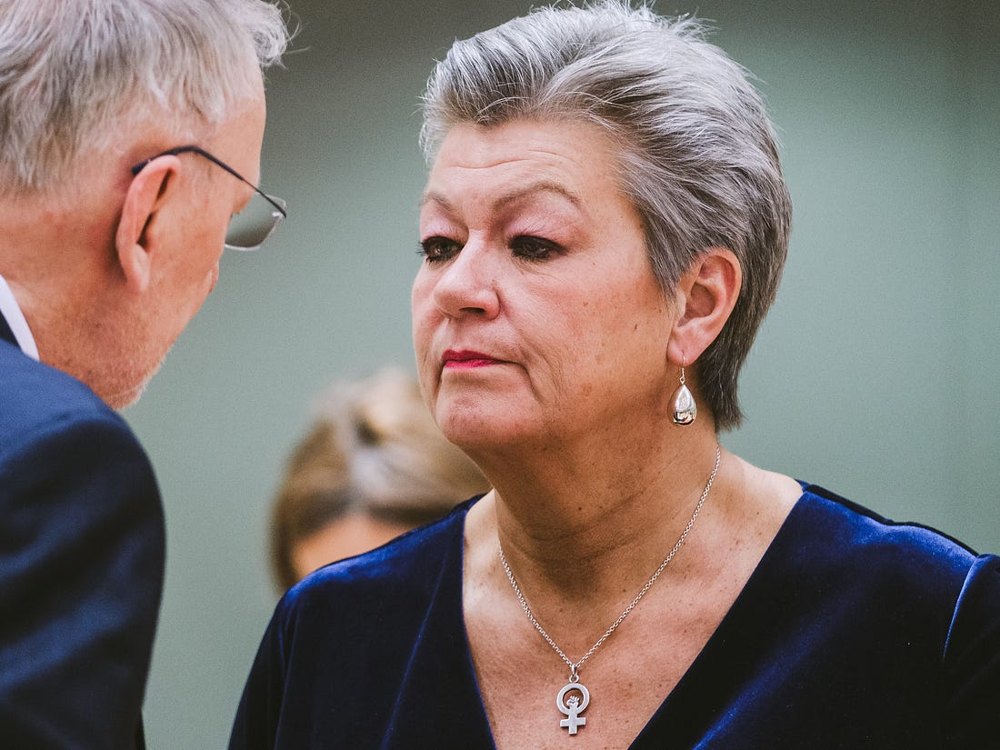
European Politicians Declare War On Text Message Privacy
The same EU politicians who are trying to censor the Internet now want to read all of your personal messages and break encryption. With Alex Gutentag.
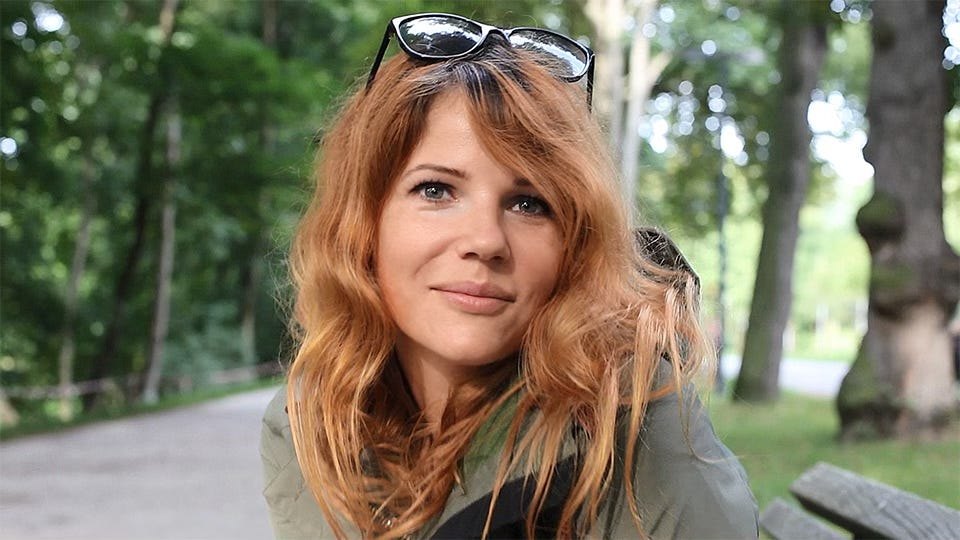
“My Country Is Returning To Totalitarianism,” Warns Daughter Of Legendary Czech Freedom Fighter
Evidence that the US government, the European Union, and George Soros are funding a crackdown on free speech in the Czech Republic.
Contact
Send me a message using the form below and I will reply by e-mail.