A Family Against Tyranny
Three generations of Cecílie Jílková’s family stood up to two totalitarian regimes. Her great-grandfather was tortured to death by the Gestapo, her grandfather was hounded to death by communist propaganda, her father spent two decades as a banned writer, and her mother became an enemy of the state at eighteen. Their stories run through everything she writes.
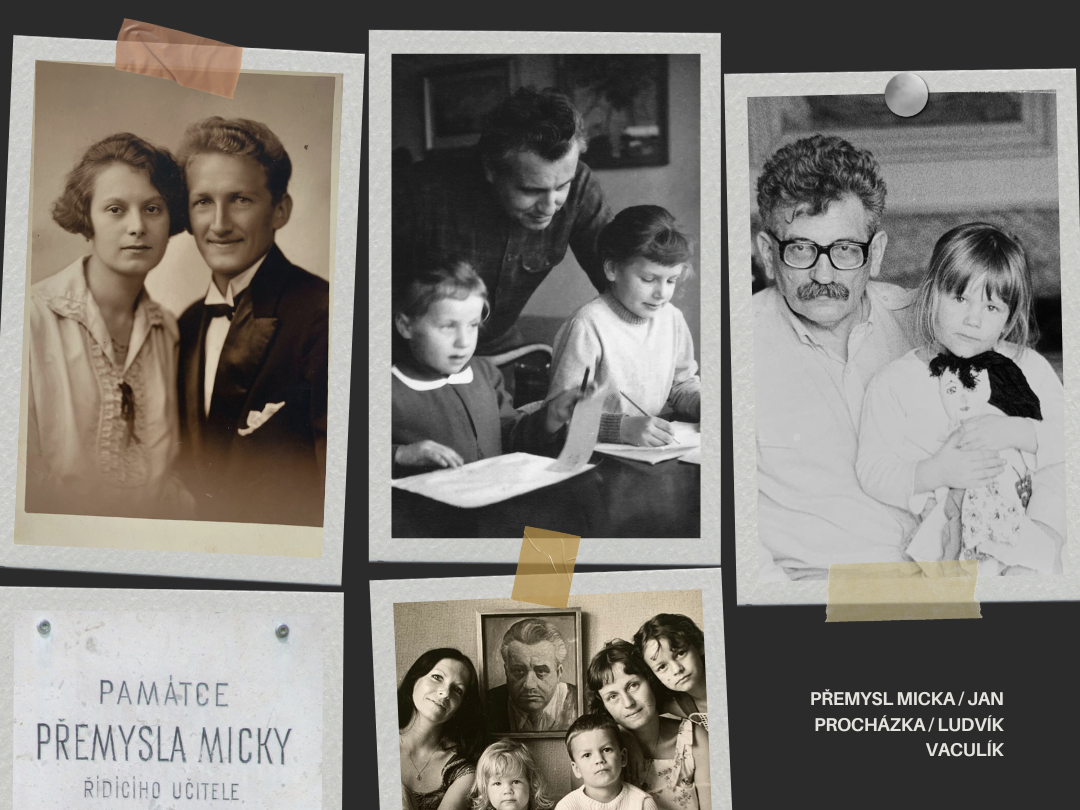
Three fathers of the family: Přemysl Micka, Jan Procházka and Ludvík Vaculík.
Přemysl Micka (1900–1944)
Her great-grandfather was a headmaster who founded the first Czech school in Střítež, a village on the Polish border where part of the population was Polish. He kept sending complaints and proposals for improvement to the school authorities, who in return kept posting him to the remotest villages. On 30 September 1938 the school became the target of a hateful night attack and the family had to evacuate; all they took with them on the back of a truck were clothes and books. Cecílie tells the story here (in Czech).
They found a new home in Třebětín near Brno, where he again ran the local school and a summer home for poor children from the city, while working for the anti-Nazi resistance. Arrested by the Gestapo, he was imprisoned in the Kounic Halls in Brno, where he died from the effects of torture during interrogation. His daughter Mahulena was thirteen. His arrest is retold in Jan Procházka’s novel Přestřelka (The Shootout), where the teacher’s daughter is called Arnoštka.
Pat and Patachon moved about the school almost shyly; with a good-natured look they kept apologizing to Mother, who was terrified, stood by the wall, sobbed, and kept saying that Father hadn’t done anything.
Yes, they said, in German-Czech. Of course.
They didn’t turn the wardrobes over, they didn’t empty the drawers onto the floor; they asked, for about the fifth time, where Father kept his camera.
They asked everyone: Přemek, Zdeněk, Arnoštka.
Everybody knew that he didn’t have one, had NEVER had ANY camera.
They took the blanket from Arnoštka’s bed; it had a dark pattern of squares and triangles.
But this is your blanket, isn’t it?
Mother said nothing.
Father swallowed.
They pulled out the photographs: it was the two men Father had photographed against the wall in the yard; he had stretched that very blanket behind their heads so that the portraits for the false identity cards would look convincing.
(The two were called Vladimír and Franta; for several months they had been hiding in a barn in Nýrov; they wanted to cross the border in November, before the snow fell.)Jan Procházka, Přestřelka (The Shootout, 1964; not yet translated into English): the arrest of the village teacher, modelled on Přemysl Micka. “Pat and Patachon,” the Gestapo pair, are named after the Danish film comedians of the silent era.
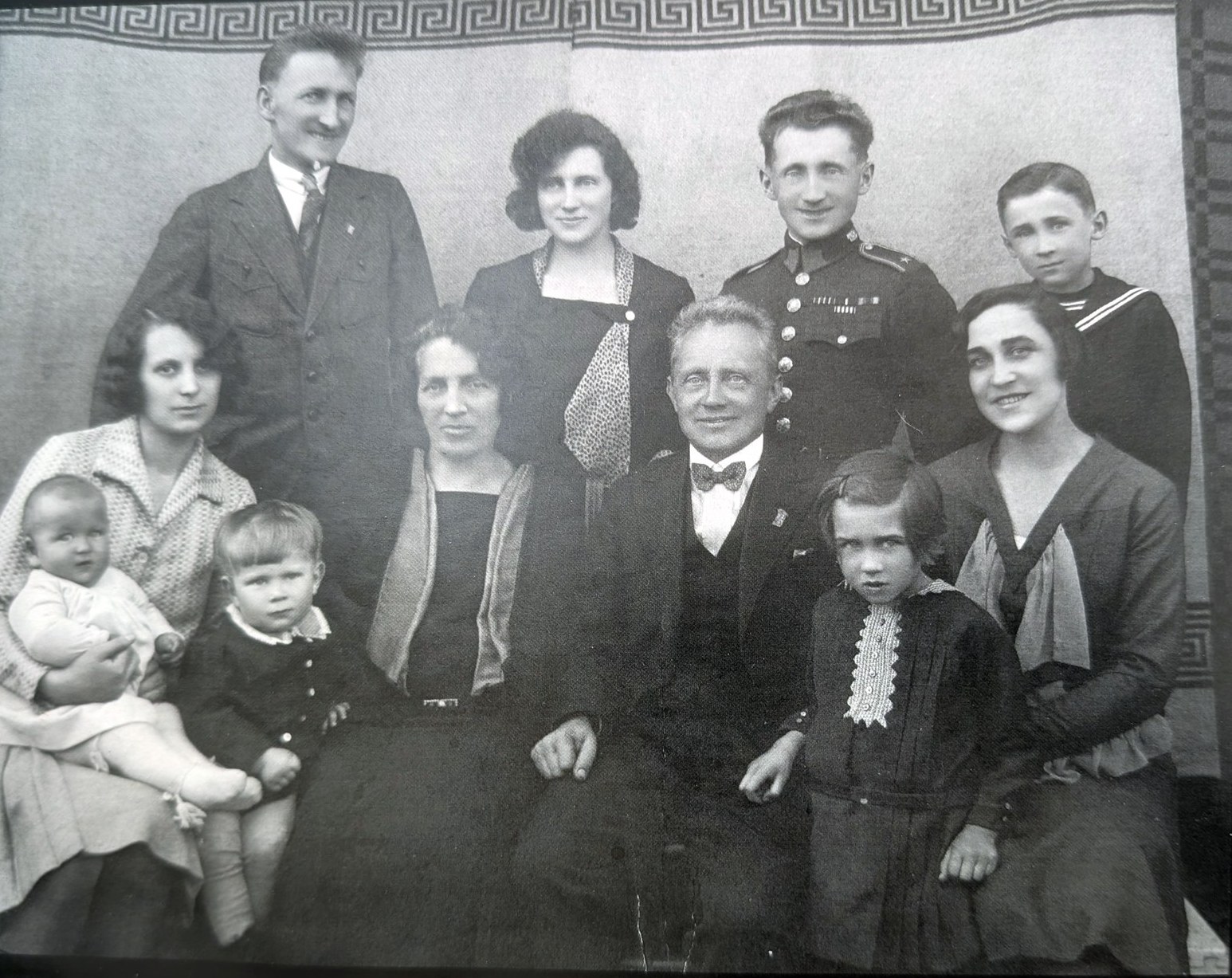
The Micka family, 1930. Standing: Přemysl Micka, his sister Květuška, his elder brother Miloň and Miloň’s son Libor. Seated: Přemysl’s wife Marie with their children Mahulena and Radúz, grandmother Zdeňka, grandfather Otakar, and Miloň’s wife Miluše with her daughter Svatava. Zdeněk, whose archive the photograph comes from, was not yet born.
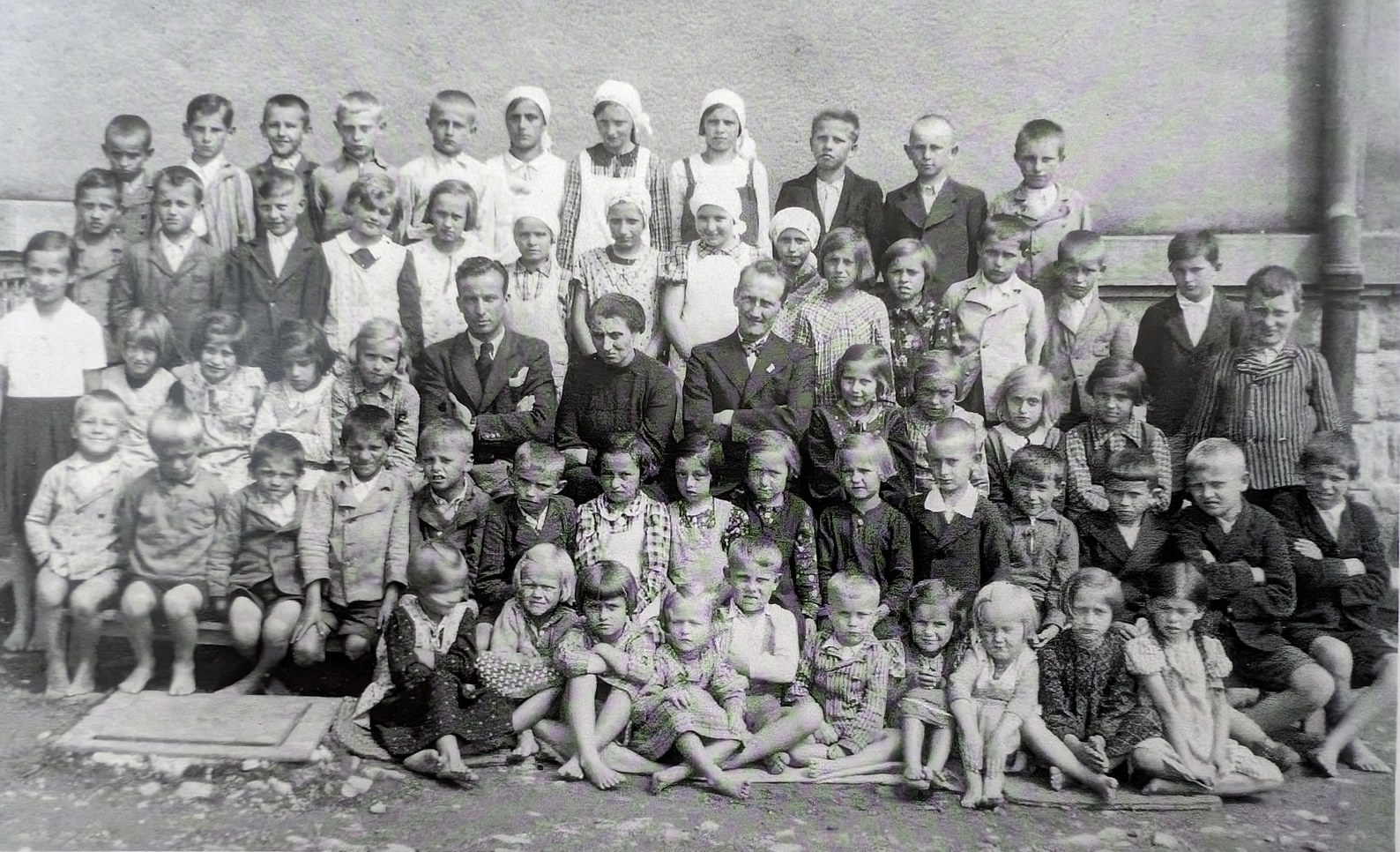
End of the school year at the Střítež school, 1937. Přemysl Micka as headmaster in the centre, with the kindergarten teacher Miss Kašková and the school’s second teacher on his right. Among the children are his own three: Mahulena on his left, Zdeněk sixth from the right in the front row, and Radúz third from the left in the second row from the back. From the archive of Zdeněk Micka, Mahulena’s brother.
Jan Procházka (1929–1971)
Mahulena later married a boy from Ivančice, Jan Procházka. He became one of the leading novelists and screenwriters of the Czechoslovak New Wave, known above all for his long collaboration with director Karel Kachyňa (Long Live the Republic!, Coach to Vienna, The Ear), and vice-president of the Writers’ Union during the Prague Spring. After the Soviet invasion of 1968 he was denounced in the Soviet press as an “anti-socialist” writer, expelled from the Communist Party and banned; films made from his scripts ran without his name in the credits.
Following a smear campaign in state television and the party daily Rudé právo, he died of cancer at 42. As The New York Times reported, some 500 people defied the secret police to attend his funeral. Ludvík Vaculík, who had publicly defended him during the campaign, was one of those who carried his coffin.
“He was diagnosed with colon cancer in 1970, just as all the campaign against him was reaching its peak. And few people are in any doubt that it was at least accelerated by the situation that he was in.”David Vaughan, author of the afterword to the English edition of The Ear, in an interview with Radio Prague International · Read the full interview ↗
Listen to the interview (14 min) · Radio Prague International, 2023
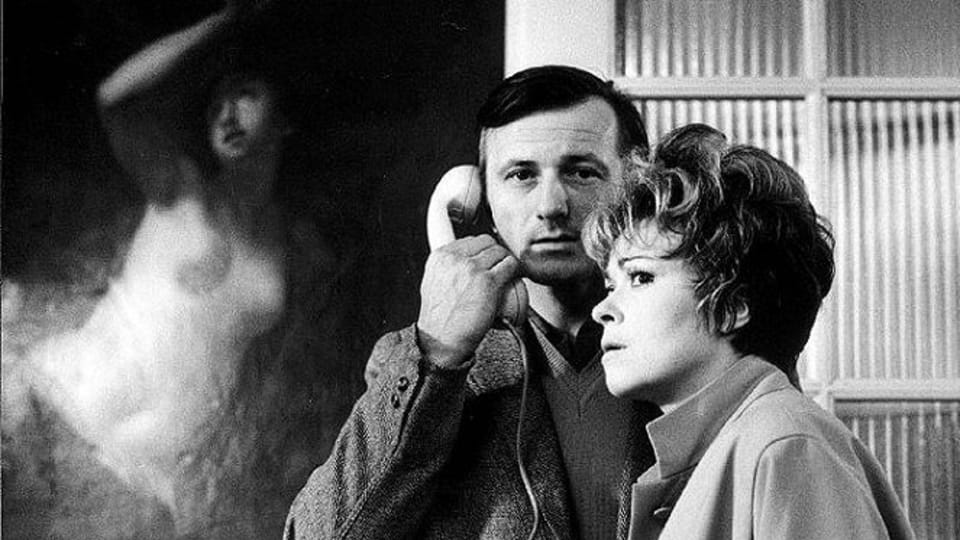
The Ear (Ucho, 1970), directed by Karel Kachyňa from a screenplay by Jan Procházka. Trailer with English subtitles; the full film is on YouTube.
Short documentary about the persecution and death of Jan Procházka, featuring Václav Havel and Ludvík Vaculík (in English).
Ludvík Vaculík (1926–2015)
Cecílie’s father was expelled from the Party after his defiant speech at the 1967 Writers’ Congress, in which he described the laws by which every power behaves. In June 1968 he wrote Two Thousand Words, the manifesto that helped provoke the Kremlin into invading Czechoslovakia. Censored for more than two decades, he ran the underground publishing house Petlice, which circulated banned books in typewritten copies, and in 1977 helped Václav Havel organize Charter 77. Because his books were published abroad, the secret police could not afford to beat him during interrogations; the regime, as Cecílie writes, always behaves worst toward the unknown. The New York Times obituary called him “a leading Czech writer, dissident and intellectual.”
“The first law of every power is that it wants to continue to be. It reproduces itself in an ever more precise form. Secondly, it constantly homogenizes itself, purges itself of whatever is heterogeneous, until each of its parts is an image of the whole.”Ludvík Vaculík, speech at the Fourth Congress of the Czechoslovak Writers’ Union, June 1967 · Read the full speech (PDF) ↗
The Fourth Congress of the Czechoslovak Writers’ Union, held in Prague on 27–29 June 1967, became the first open revolt of the country’s intellectuals against the Party and a prelude to the Prague Spring. Its speeches were published in English in 1971 as Writers Against Rulers, together with an eyewitness account by Dušan Hamšík, editor-in-chief of Literární noviny, the weekly where Vaculík worked. Hamšík recalled that the speech sounded bitter rather than fiery, and that by the evening he and his friends expected Vaculík to be arrested:
“His delivery was calm and factual; he neither gestured nor raised his voice.”Dušan Hamšík, Writers Against Rulers (London: Hutchinson, 1971) · Read the book on the Internet Archive ↗
Cecílie returned to the speech in her essay The Five Laws of Power of Ludvík Vaculík (in Czech). Her point is that the laws her father described are not laws of socialism but of power as such: they hold under any regime, and they can be watched at work today.
His most consequential text, however, came a year later. Two Thousand Words appeared on 27 June 1968 in Literární listy and three Prague dailies, signed by scientists, athletes and artists and soon by tens of thousands of readers. In Moscow it was read as a call to arms: Pravda accused its authors of trying “to pave the way for counterrevolution,” and the manifesto became one of the pretexts for the Warsaw Pact invasion two months later. Radio Prague International summed up the two turning points of his political life:
“Of his political activity, two moments stand out: the first was Vaculik’s critical speech at the 1967 Czechoslovak Writers’ Congress, for which he was expelled from the Communist Party. The second turning point came in 1968 when Ludvik Vaculik wrote his ‘Two Thousand Words’ manifesto, which criticized the regime and ensured that he would not publish officially for the next 21 years.”Linda Maštalíř, Radio Prague International · Read the full article ↗
Listen to the programme (11 min) · Radio Prague International, 2006
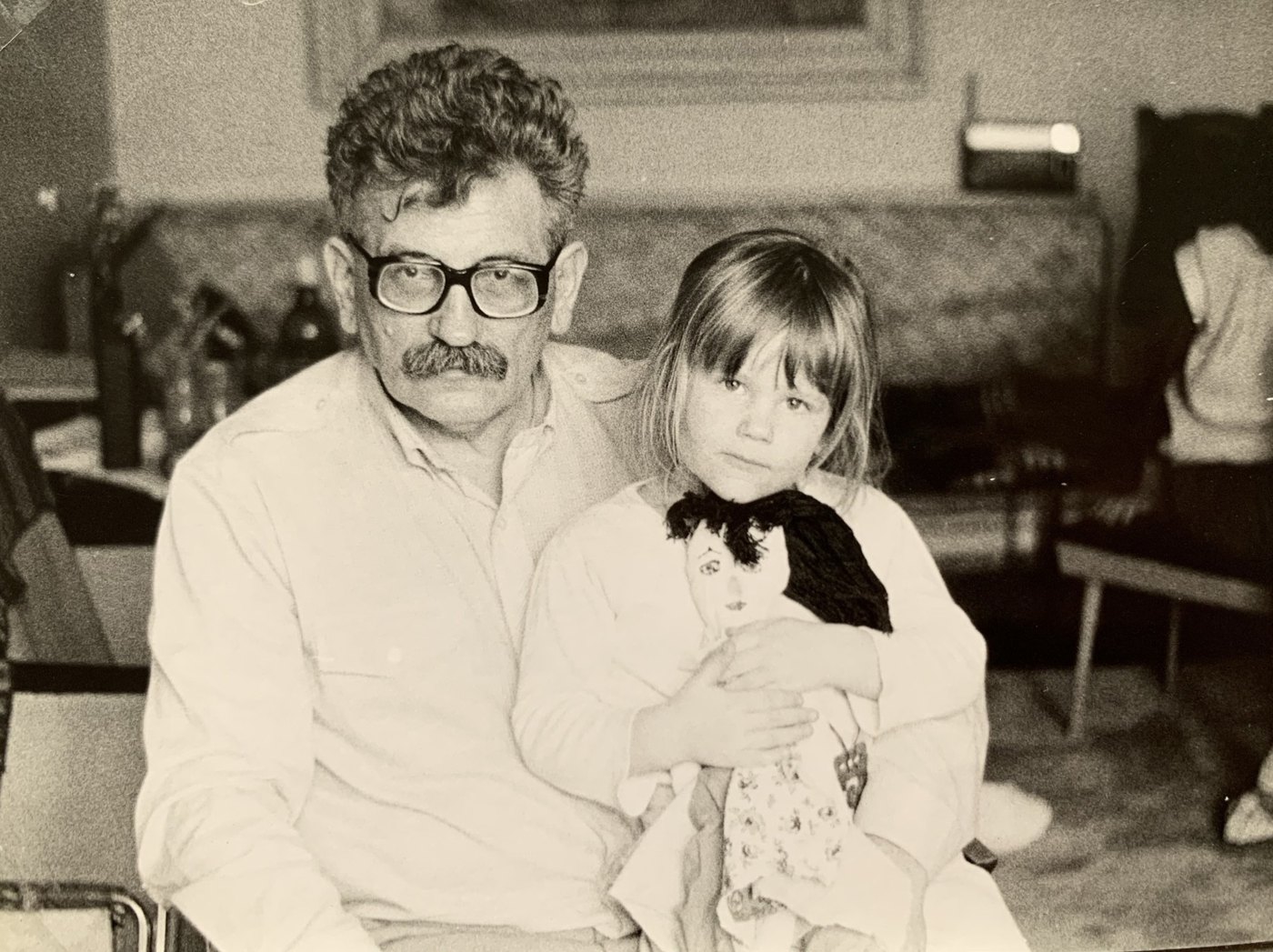
Ludvík Vaculík with Cecílie in the old Lhotka apartment, Prague, 1986.
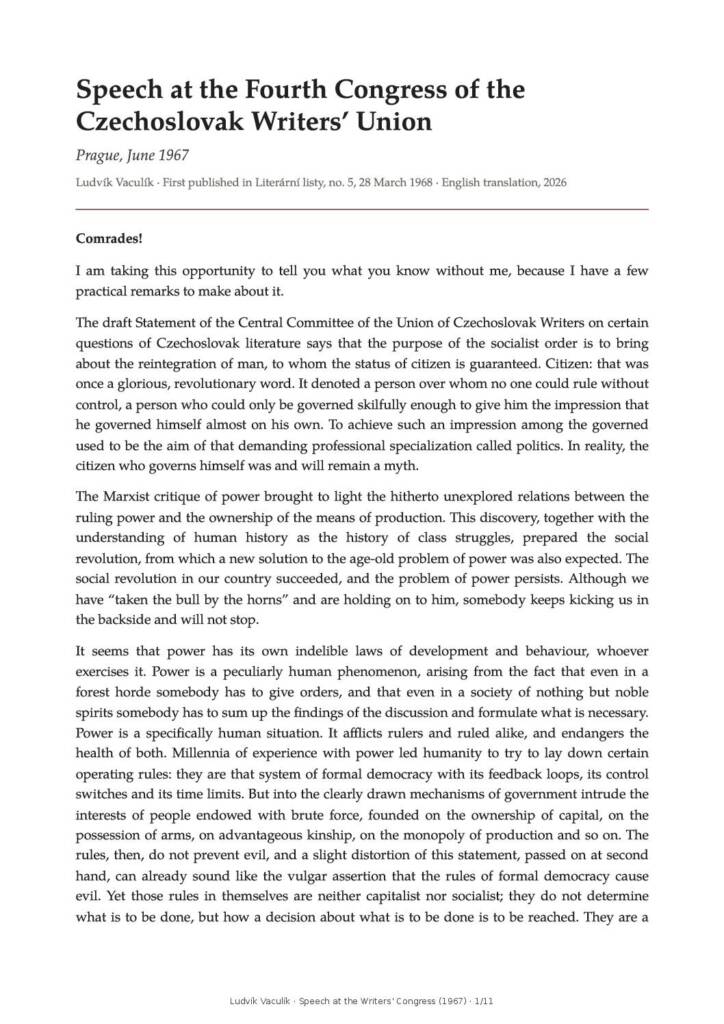
Speech at the Fourth Congress of the Czechoslovak Writers’ Union (June 1967), complete, in English translation. Open the PDF ↗
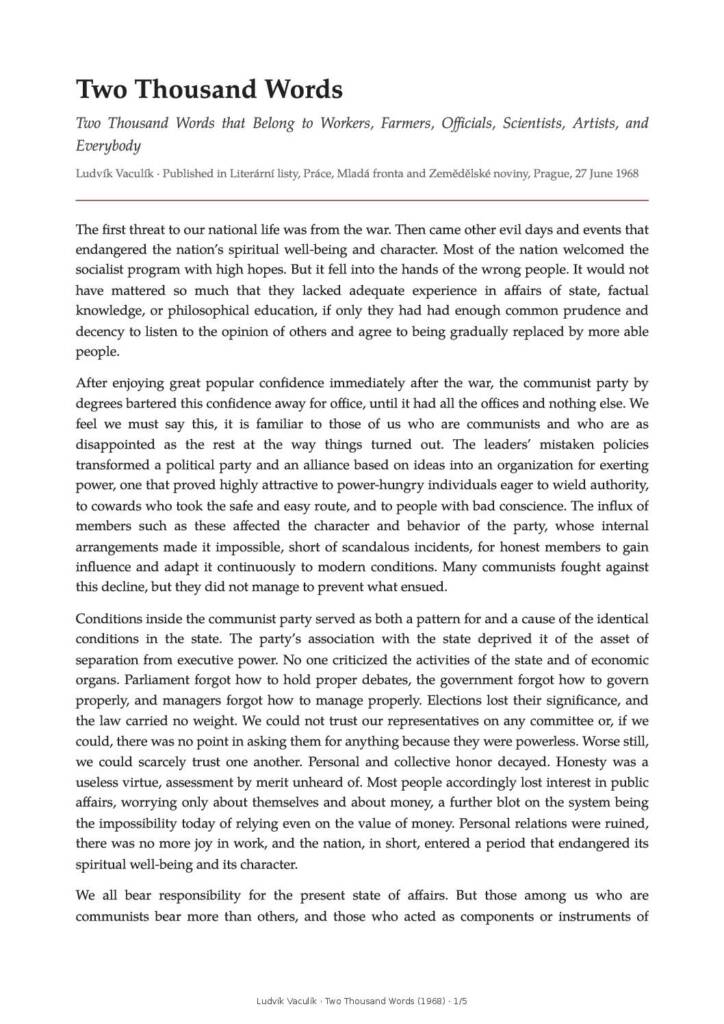
Two Thousand Words (27 June 1968), the complete manifesto in English translation. Open the PDF ↗ · Source: Prague Writers’ Festival ↗
Lenka Procházková (born 1951)
Jan Procházka’s daughter and Cecílie’s mother became an “enemy of the state” at eighteen simply by inheriting her father’s name. Banned from publishing, she signed Charter 77 and was forced into manual work until 1989; for a time the only job she was allowed was cleaning the stairs of a theatre. Her books came out in samizdat and with exile publishers. Cecílie grew up in the family’s bugged Prague apartment, where the StB kept a car parked outside and her kindergarten teachers questioned her about who came to visit.
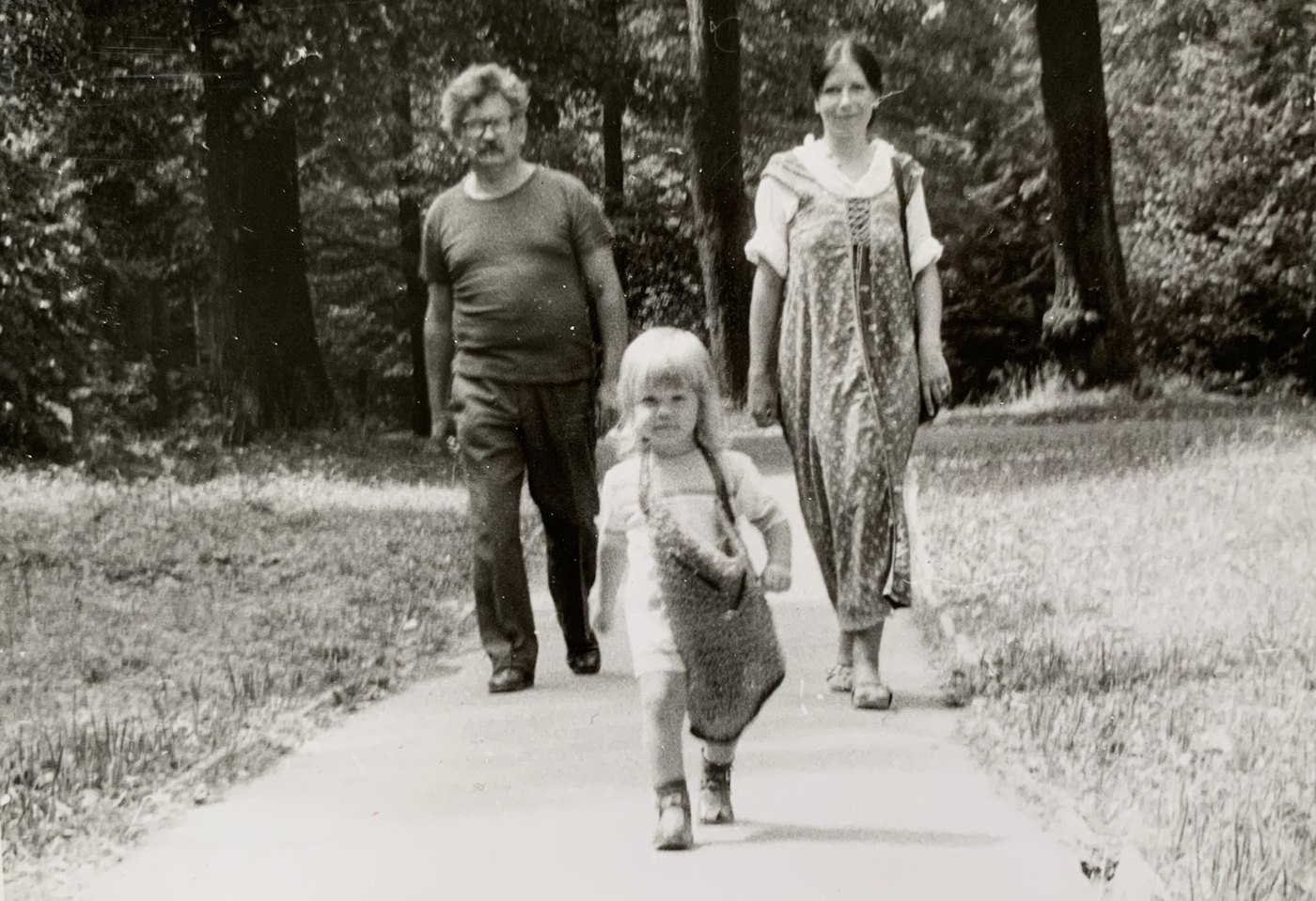
Cecílie with her parents, Ludvík Vaculík and Lenka Procházková, early 1980s.